
This year, the Changemaker series will focus on women in AI in research, investing and trading, decision-making and more.
Worldwide, women are leading the way in building and funding disruptive technologies in fintech, as well as advancing businesses, broadening access, reducing wealth disparity, and transforming how people invest. Many of these leaders are featured in 100WFinTech’s Public Directory. They are the changemakers in their fields.
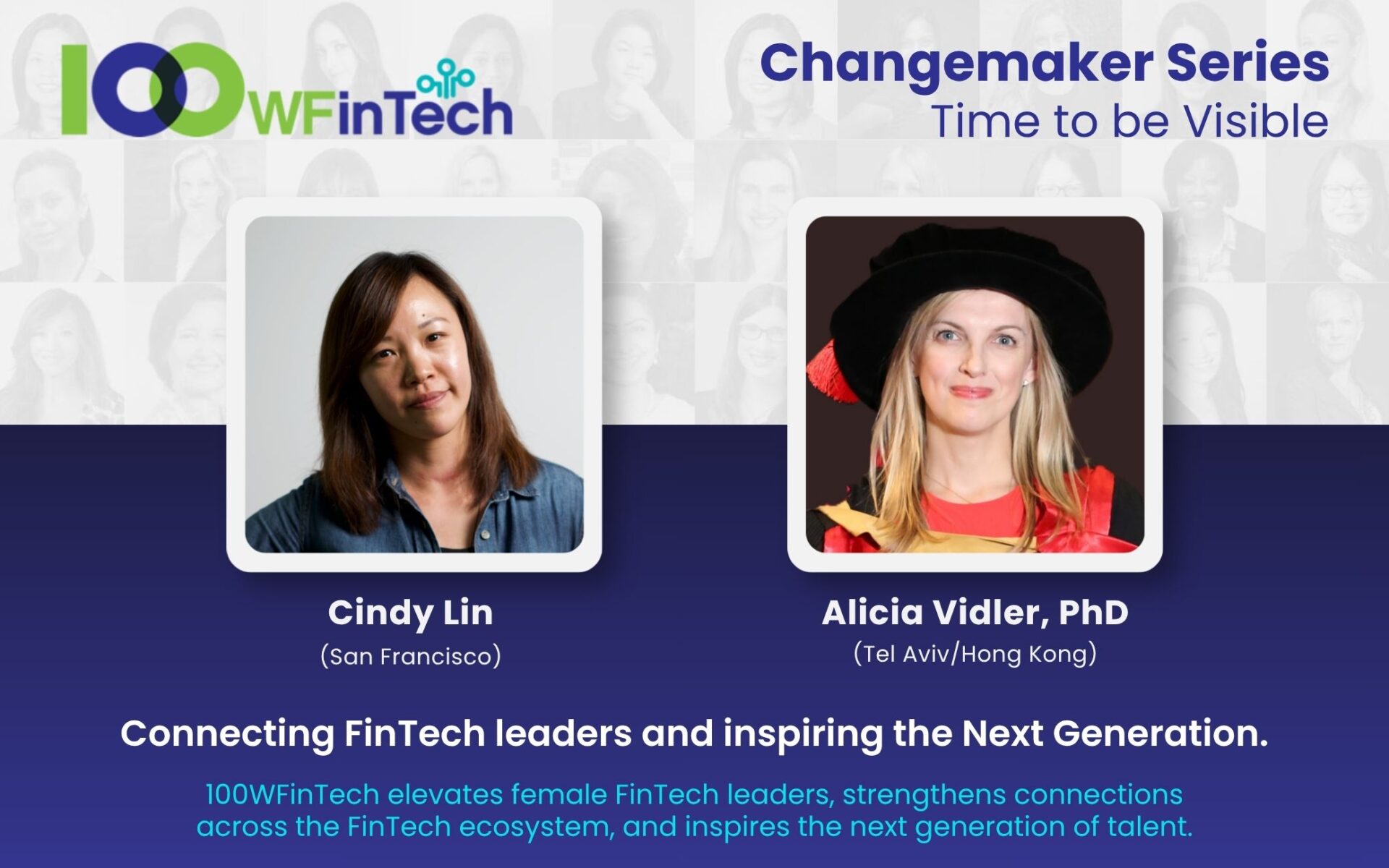
In this 100WFinTech Changemakers series, we highlight Cindy Lin (US) and Alicia Vidler, PhD (EMEA/APAC), two senior Finance/AI leaders who have created opportunities through thought leadership, investing, teaching, and community building. In the process, they open doors for women investors and diverse founders and broaden financial access.
As AI reshapes financial services, this series expands to champion women at that frontier. It is the natural home for stories connected to 100WF’s AI Academy — our new global webinar series helping finance professionals build AI-augmented skills for career and market advantage. The Changemakers we profile embody what the AI Academy seeks to cultivate: the confidence and capability to lead at the intersection of finance and technology.
If these stories resonate, share them, join the 100WFinTech Public Directory, or learn more about the AI Academy. We are always looking to feature Changemakers, especially those driving AI innovation in financial services. Get in touch.

Cindy Lin
Quantitative Researcher and AI Practitioner | Founder, Mindful Data
Adjunct Instructor at WorldQuant University
Location: US
Website: https://mindfuldatabycindy.substack.com/
LinkedIn: https://www.linkedin.com/in/cindylintw/
First, we chat with Cindy Lin, who is the Founder of Mindful Data, an AI innovations newsletter focused on applications in quantitative research and finance. She is also a faculty member at WorldQuant University, where she teaches quantitative finance. With over 20 years of industry experience, Cindy has held senior quantitative roles, most recently as Senior Director of Data Sciences and Quantitative Portfolio Manager at Bundles. Her work centers on leveraging open-source and AI tools to streamline workflows and broaden access to careers in finance.
▪ ▪ ▪
Can you share some pivotal moments of your career journey – from quantitative finance, data scientist, to instructor in quantitative finance and AI? What are some lessons learned?
I would like to share two pivotal moments in my career. The first took place when I decided to leave large financial institutions and pivot to startups. Throughout my career, I have been very fortunate to work with teams and companies that truly understood and appreciated my contributions. I was especially lucky to work with the same manager for more than eight years. Each time he moved, I was offered a role on his new team. It was difficult to part ways, as he trained me, taught me interest rate derivatives, and provided strong support by shielding me from office politics. However, I realized I was no longer growing or learning. I was building similar quantitative models repeatedly across different currencies. I stepped out of my comfort zone, moved back to the United States, and joined the startup world. It was a difficult decision, but it allowed me to grow exponentially and take on a wider range of responsibilities. The key lesson was to prioritize growth and continuous learning.
The second pivotal moment took place right after my maternity leave and was a significant lesson. I joined a startup immediately after returning to work, but it turned out to be a challenging experience for both me and the company. I was still adjusting to motherhood, which made it difficult to meet the demands of a young startup. In addition, the founders and I had very different working styles, and despite multiple attempts, we were unable to align. We mutually decided to part ways, which felt like a major setback at the time.
Looking back, I have had a mix of experiences. Some employers deeply valued my work and continued to seek opportunities to work with me, while others were simply not the right fit. The lesson is that once you have built a strong foundation of skills and experience, it is okay to acknowledge when a working relationship does not work. It is equally important to take the time to find an environment and team that truly fit you. It is also okay to slow down and not rush into opportunities before you are ready.
What excites you the most right now and why?
What excites me the most right now is applying the latest AI tools and techniques across different areas of my life. This includes quantitative research, investment workflows, and improving efficiency in both my professional and personal life. The pace of innovation is incredible, and the ability to integrate these tools into everyday workflows creates meaningful impact and new opportunities.
I am also constantly learning and exploring creative ways to use AI. In particular, I have been closely following the latest innovations that can be applied in finance. For example, I am seeing a growing trend among financial data providers to offer ways to integrate their data with large language models (LLM) through MCP. At the same time, I am seeing the emergence of AI agents that can improve investment workflows, with some even being usable directly within LLM chat environments. These developments are opening up new possibilities for how research and decision-making can be done more efficiently.
How should women in investment navigate the era of AI? What’s the edge of AI in investing?
Women in investment should actively explore AI tools, but without feeling overwhelmed. Subscribing to curated resources and learning about the latest tools is a great starting point. At the same time, it is important to focus on mastering one tool at a time rather than trying to learn everything at once. AI should also be used creatively, not just for work, but to improve overall efficiency. In many ways, life itself can be seen as an optimization problem.
The edge of AI in investing is not just about quantitative trading, which already relies heavily on machine learning models. Instead, AI enables smaller asset management firms, startups, and even solo advisors to compete with larger institutions. In this context, designing systems with a human in the loop is a powerful way to incorporate AI into investment workflows while maintaining judgment and oversight.
What advice would you give to younger women in finance or your younger self?
See your life as an optimization problem. Early in your career, you may choose to optimize for performance, promotions, and building professional experience. As you progress, your priorities may shift toward work-life balance, family, or other commitments. Do not be afraid to pivot and redefine what you want to optimize for, whether that is time, flexibility, or new experiences such as travel.
Early in my career, I focused heavily on financial outcomes. While it felt rewarding in the moment, the happiness was often short-lived. Over time, I realized that material achievements did not bring lasting fulfillment. Today, I optimize for happiness and for what brings joy to me and my family. I can confidently say that this is the best phase of my life. The most important advice is to understand what truly matters to you and optimize for that. Do not be afraid to shift your focus as your life evolves.

Dr Alicia Vidler
Head of AI @ Capitolis
Location: Tel Aviv (soon to be Hong Kong)
Publication or course links: https://scholar.google.com/citations?user=hGUQwZMAAAAJ&hl=en
Dr. Alicia Vidler is a leading expert at the intersection of artificial intelligence and financial markets, with over 25 years of experience spanning trading, quantitative research, and AI system design. She has spent more than 17 years in capital markets, where she has developed and deployed machine learning-driven trading strategies, agent-based models, and institutional investment platforms across equities, fixed income, and credit markets. She later co-founded Castilium Capital, an AI-based hedge fund, where she served as CIO. Following her exit, she has advised global executives, boards, and fintechs on AI strategy and development, and now serves as Global Head of AI at Capitolis. Alicia completed her PhD in Agentic AI at UNSW, focusing on multi-agent systems and LLMs in financial markets. She serves on the editorial board of the Journal of Financial Data Science, contributes to leading academic conferences, and is the author of the forthcoming Springer book Agentic Intelligence – AI Methods for Bond Markets. She is relocating to Hong Kong in 2026.
▪ ▪ ▪
Can you share some pivotal moments of your career journey? What are some lessons learned?
A pivotal moment in my career was the transition from leading Castilium Capital to stepping back into academia to pursue a PhD in Agentic AI. After years of building and deploying AI-driven trading systems in a live investment environment, I recognised that the next frontier of innovation required deeper research into autonomous systems, multi-agent models, and the evolving role of AI in complex markets. That shift marked a move from applied, performance-driven investing to foundational research at the frontier of AI.
One of the most important lessons from that journey has been the need to communicate highly technical ideas in a clear and commercial way. Working across both institutional finance and advanced AI research taught me that even the most sophisticated models only create value if they can be understood, trusted, and implemented by decision-makers. Bridging the gap between technical depth and practical business relevance has become a defining part of my work.
What in the world of AI inspires and excites you the most?
What excites me most is the science of how machines make decisions—what we would more formally call algorithmic decision-making. This opens up rich areas such as computational game theory and reinforcement learning.
My current academic work focuses on reinforcement learning in highly unpredictable environments like financial markets, particularly crypto. When combined with Agentic AI, these approaches move us closer to systems that can act autonomously in complex, dynamic settings. More broadly, I’m excited by the shift from AI systems that primarily predict or analyse toward systems that can decide and act. That, in my view, is where the next major leap in AI will occur.
What is one thing in your field that people don’t know about or don’t talk enough about?
We don’t talk enough about how humans actually make decisions—or fail to make them. As a result, when people evaluate AI systems, particularly in areas like trading, they often underestimate the complexity involved.
Agentic AI is a good example. A core question is “agency”: what decisions should a system be allowed to make, and what real-world impact should it be able to have? How do you restrict or curtail agency, and how do you make the most of it?
What advice would you give to younger women in finance who may want to leverage AI in career advancement or build using AI?
Focus on developing both depth and breadth. Deep subject matter expertise is essential, but what differentiates people—especially in AI and finance—is the ability to connect ideas across domains and communicate them effectively.
Avoid being overly pigeonholed early in your career. While depth can often be built independently, breadth is usually developed through exposure—working across teams, industries, and problems. Strong, active professional networks are a critical part of that.
Ultimately, human relationships remain a powerful—and often underestimated—driver of opportunity. They are just as important as technical skills when it comes to building anything meaningful, including AI systems.
▪ ▪ ▪
We are grateful to both Cindy and Alicia for sharing their unique journeys, insights into their respective field, and the valuable advice for younger women in finance or those who want to leverage AI in their careers.
Events organized or co-hosted by 100WFinTech in the past 6 months and upcoming in Q2 2026
Past 6 months:
September 1, 2025, London, Redefining Retail Investing: The Tech Revolution, speakers: Andrew Bresler, Saxo UK, CEO; Devika Mathur, BlackRock; Stacey Parsons, RetailBook; Abhay Pradhan, LSEG; Lauren Crawley-Moore, LSEG, hosted by LSEG
October 22, 2025, Webinar, No-Code in Action: Build Your Business App in Minutes, speakers: Dr Alicia Vidler, Capitolis; Elsa Welshofer, Wix and Base44, hosted by Base44
March 16, 2026, San Francisco, What’s AI Investment Edge? Evidence, Practice, and Tools, speaker: Cindy Lin, WorldQuant University, hosted by Brown Advisory
April 23, 2026, Switzerland, The Evolution of Digital Assets and Female Fintech Leadership, speakers: Lidia Kurt, BX Digital; Cecilia Müller Chen, Comply Now, hosted by BX Digital
May 10, 2026, London, Practical AI Adoption for Female Founders in Fintech, speakers: Ally Clegg, Google; Hollie Greenaway, Barclays; Sarah Hobbs, Barclays; Tram Anh Nguyen, CFTE; Emanuela Vartolomei, Sevva AI; Rachel Tshondo, Barclays (moderator), hosted by Barclays Eagle Labs
Upcoming:
May 21, 2026, Hong Kong, Understanding Alternative Investments: The What, Why and How, speakers: Steffanie Yuen, Endowus; Mandy Lee, Brookfield; Joyce Ho, iCapital; Connie Sin, Nomura International Wealth Management, hosted by Brookfield and Endowus
AI Academy Webinars:
June 8, 2026, How Senior Women Leaders Can Lead in the AI Era, speaker: Tram Anh Nguyen
July 29, 2026, AI in Investing, speaker: Cindy Lin
September 8, 2026, Building AI Agents, speaker: Emma Vartolomei
▪ ▪ ▪
This is the fifteenth article of our Changemakers in FinTech series. We will continue to feature FinTech book authors, TED Talk speakers, lecturers, and influencers from around the world.
If you are interested in partnering with us at 100 Women in FinTech, please visit our website and contact us here.