Worldwide, women are leading the way in building and funding disruptive technologies in fintech to advance businesses, broaden access, reduce the disparity in wealth, and transform how people invest in digital assets. Many of these women are featured in 100WFinTech’s Public Directory and are the changemakers in their respective fields in FinTech.
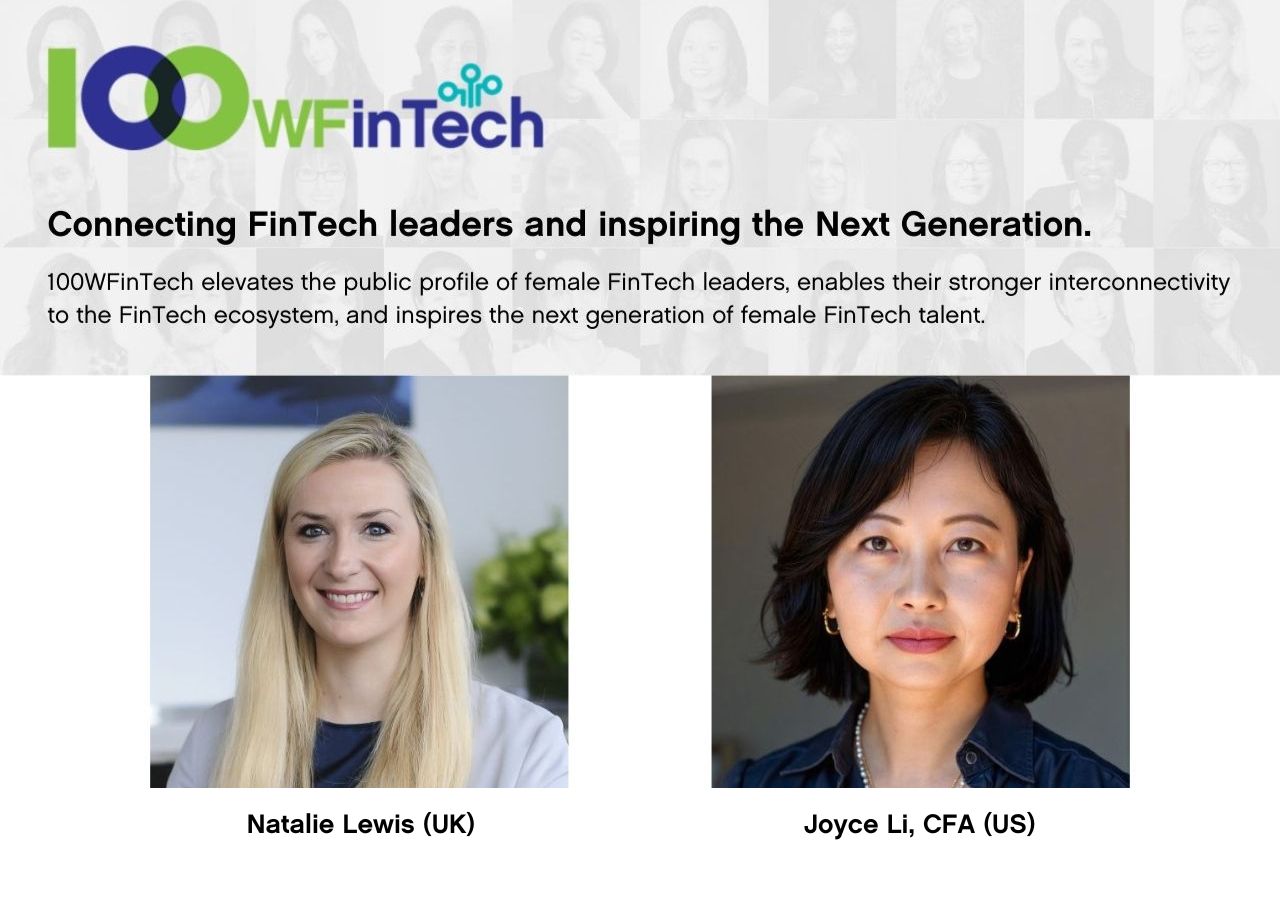
In the ‘100WFinTech Changemakers’ series, we highlight Natalie Lewis (UK) and Joyce Li (US), two senior FinTech leaders who have created and leveraged opportunities that were open to them via their thought leadership, writing, entrepreneurship, investing, and community building. In the process, they open doors for women investors and diverse founders and broaden financial access for many. We hope the stories of these female FinTech leaders can inspire the next generation of finance professionals to build a better and more inclusive world by leveraging technology.
If these stories and missions resonate with you, please share them with your network, get in touch with us, or join the 100WFinTech Public Directory.
We are always looking for Changemakers to profile. Please contact us if you know someone we should feature.
 Natalie Lewis
Partner, Head of Fintech, Market Infrastructure and Payments of Travers Smith LLP
Location: United Kingdom
Website: https://www.traverssmith.com/| https://www.traverssmith.com/people/natalie-lewis/
LinkedIn: https://www.linkedin.com/company/travers-smith/| https://www.linkedin.com/in/natalie-lewis-50798734/
Website: https://www.traverssmith.com/| https://www.traverssmith.com/people/natalie-lewis/
Publication links: Fintech-related briefings are found here.
First, we chat with Natalie Lewis, a Partner in Travers Smith’s Financial Services & Markets Department who leads the firm’s cross-disciplinary Fintech, Market Infrastructure and Payments (FMIP) Group. Natalie works with financial market infrastructures, payment institutions and other fintech clients, particularly in the fast-moving and highly innovative clearing, settlement and payments space, and in relation to the development of new platforms and products using DLT and cloud technologies. Natalie advises the main UK and international payment and settlement systems on the broad spectrum of UK, EU, and other international laws and regulations affecting them. These clients are responsible for transactions involving trillions of pounds worth of financial assets daily. They also provide complex fintech infrastructure, which is integral to the day-to-day operation of the world’s financial markets and systems. She is an acclaimed thought-leader in this area and speaks regularly to assist the firm’s financial market infrastructures (FMI) clients and expert market groups on prospective reforms affecting financial market participants. Natalie is also the partner sponsor of Travers Smith’s Gender Balance Group.
▪ ▪ ▪
What brought you into the fintech sphere, and why does it interest you?
I am a regulatory lawyer, although I should add that working with fintechs means that I also have to use many other skills! My firm, Travers Smith, has a uniquely illustrious history of advising groundbreaking financial market infrastructures (FMIs). Most notably, we were the legal advisers on the establishment of CREST, the UK’s central securities depository, decades ago. The “dematerialisation” of securities achieved by CREST was a major innovation, completely reshaping the operation of the UK capital markets. We have remained their regulatory counsel ever since. The firm also played a pivotal role in the consolidation of the UK’s retail payment systems under the umbrella of Pay.UK nearly 10 years ago. We are currently working with a highly innovative business looking to establish a new cross-border payments system. I often say that our FMI clients were fintechs before the word entered common parlance!
I took over the leadership of the firm’s Fintech, Market Infrastructure and Payments practice over six years ago. The foundation we have with our FMI clients allowed me to naturally build out my practice into working with innovative fintechs and payment services businesses, including open banking platforms, digital assets firms, card issuers, money remitters, embedded finance providers, acquirers and – increasingly – technology businesses that are confronted with challenges relating to their payment needs.
What I particularly love about working with fintechs is what I call “the whiteboard perspective” – we are often presented with completely new issues that are on the absolute bleeding edge of the law as it relates to innovation. Every day is different!
What are your hot topics and priorities at the moment?
There are really three topics that are occupying me and many of my clients: stablecoins, payments infrastructure, and AI.
On stablecoins, the UK is at a real inflection point (and this actually goes for digital assets more broadly). The government is legislating to bring digital assets into regulation by the Financial Conduct Authority (FCA), and, in parallel, the FCA and Bank of England are drafting and consulting on their proposed rules. This is a positive development – I am strongly of the view that proportionate, evidence-based and appropriate regulation encourages investment, adoption, and growth; however, many in the industry would like regulators to move more quickly and have serious concerns about the impact that some of the proposals will have. To take just two examples: first, the Bank of England favours capping the amount of stablecoins issued by systemically important issuers that people and businesses can hold. Some view this as a literal constraint on growth. Secondly, the FCA’s proposals on the prudential regime for stablecoin issuers are both complex and onerous, and I am not alone in my concern that they might discourage the emergence of the sector in the UK.
Connected to stablecoins is the issue of payments, and specifically, the future evolution of next-generation retail payments infrastructure. Before the end of the year, a body of government officials, central bankers and regulators called the Payments Vision Delivery Committee (so-called because this has come out of the government’s “National Payments Vision” of November 2024) will publish the Payments Forward Plan, which will hopefully be a sequenced, prioritised and delivery-focused plan for the UK payments sector. I hope it will include proper milestones, controls and accountability for delivery.
The use of AI is, of course, increasingly ubiquitous, and an area in which I have a particular interest is the convergence of payments and AI as AI agents evolve – with autonomous agents potentially in control of our money, a panoply of legal issues could arise. It’s an exciting time to be a FinTech lawyer!
What advice would you give to someone looking to make an impact as a lawyer in the fintech sector?
It is essential to build a personal brand and a network. A big part of building your personal brand is to get comfortable doing things your way – while it’s important to find mentors and people you respect, we are all individuals, and you have to be yourself. When you’re under pressure, you will be authentic, however hard you try to present differently.
When it comes to creating a network, be generous with your time, your knowledge and indeed your connections – introducing people to each other gets repaid many times over, in my experience.
And most of all – it is an inherently fascinating area, so it’s highly stimulating and enjoyable, so I would say: seek out areas and people that you find interesting!
 Joyce Li, CFA
CEO and Chief AI Strategist of Averanda Partners
Location: United States
LinkedIn: https://www.linkedin.com/in/sjoyceli/
Website: https://averanda-ai.com
Newsletter: https://aisimplifiedforleaders.substack.com/
Joyce Li, CFA, is the CEO and Chief AI Strategist at Averanda Partners, where she advises business leaders and board directors at the intersection of AI, finance, and governance. With nearly two decades of investment leadership and experience in founding and advising AI startups, Joyce brings a unique perspective on technology transformation and governance innovation. Recognized as a “Top Artificial Intelligence Voice” on LinkedIn, Joyce frequently shares her insights at premium business and investment forums. Joyce serves on the advisory board of OpenBB, an AI fintech company, and the investment committee of Asian Health Services. She co-authored the Athena Alliance AI Governance Playbook and created the “AI Simplified for Leaders” newsletter. She holds a Master’s in Computer Science from the University of Virginia and an MBA with Palmer Scholar distinction from the Wharton School.
▪ ▪ ▪
Can you share some of your highlights or pivotal moments in your career journey and your biggest lesson?
I started in tech with a computer science degree, building data analytics at a financial services company. I then earned my CFA charter while working full-time and transitioned into investment management. Thereafter, I spent two decades in the world of investment management, including managing institutional equity portfolios and co-founding a long/short equity hedge fund. Everything changed in November 2022 after I discovered ChatGPT at a networking event in San Francisco. Like what many people have experienced, my world shifted. I couldn’t stop thinking about all the possibilities in the finance industry this new technology could enable and transform.
Within months, I left my investment management career path, co-founded an AI-powered financial planning startup with a college friend, and began publishing on AI governance for boards. The rest is history. I now work at the intersection of AI, finance, and governance. My biggest lesson: at pivotal career moments, you don’t need permission or a predetermined path. Lean toward action and learn along the way. Your multi-disciplinary experience might not look relevant at first, but it will later become your greatest asset for differentiation.
What excites you the most right now?
Young fintech companies are using AI to leapfrog institutions that dominated finance for decades. I’m watching this happen in real time in my advisory work and conversations with leaders. Executives who felt secure five years ago are now asking, “What will our industry look like in 10 years, and how do we stay relevant?” Meanwhile, fintech startups are solving problems that previously couldn’t be solved due to scale or cost. AI agents make the attribution story from action to outcome finally work. For example, you can connect AI deployment directly to customer acquisition or revenue growth instead of vague efficiency gains. That makes the ROI calculation more compelling and changes how fast things can scale.
What excites me most is that almost no long-established beliefs and ways of doing things in finance can go unchallenged right now. Lending, payments, accounting, investing, wealth advisory, compliance – every vertical is being rethought from first principles. Companies are now asking what financial services would look like if you built them today with AI-native architecture. That’s the opportunity. We’re redesigning how finance operates, and fintech is leading that transformation.
How should board/financial services senior management navigate the era of AI?
The first thing boards and executives need to accept is that nobody has all the answers. CEOs and directors are genuinely uncertain about what’s coming, and that discomfort is actually useful because it forces real learning instead of checking boxes. The pace of change means you need to hold firm on strategic goals while staying flexible on solutions.
It is important to build real AI literacy at the board and senior management levels. Particularly, put much effort into understanding how AI creates business value in your specific context, where it fails, and what governance and guardrails you actually need. Demand ROI frameworks that connect AI deployment to real business outcomes. Ask this: How do we help our people with deep domain expertise use AI to solve problems they couldn’t solve before? That’s where multiplication happens, not headcount reduction. The organizations that will win invest in their people’s capabilities, understand the full economics, create space for experimentation, and make decisions based on business value rather than competitive pressure.
What advice would you give younger women in finance or your younger self?
Be curious, cherish rejections, and expand your surface of luck. Luck favors those who are visible, engaged, and persistent, so keep learning, build long-term relationships, and stay open to surprises.
This is especially relevant in fintech today. When things are most uncertain and dynamic, it is the best opportunity for you to differentiate and break through. The discomfort of acting before you feel completely ready is exactly where opportunity lives. And make space for other women doing the same.
Events organized or co-hosted by 100WFinTech in Q3 & Q4 are as follows:
September 1, 2025, in-person event in London, “Redefining Retail Investing: The Tech Revolution“, produced by 100WFinTech and hosted by LSEG. Key topics included democratising financial access, innovation across the UK and Europe, and how firms are using technologies to empower investors.
September 30, 2025, in-person event in Munich, “AI in Wealth: Fintech’s Innovation Frontier”, produced by 100WFinTech in collaboration with Swiss Fintech Ladies and co-hosted by Plug & Play and Allianz Global Investors, featuring Swiss & German-based FinTech start-up pitches and demos, a panel discussion and networking. The event takes place around Bits and Pretzels 2025, the largest founder festival in Munich.
October 22, 2025, virtual teach-in event, “No-Code in Action: Build Your Own App in Minutes,” produced by 100WFinTech and sponsored by Base44, recently acquired by WIX. Participants will see how AI-powered no-code technology is transforming FinTech — and will have the chance to build their own app live during this interactive session. The event showcases practical solutions for innovating quickly, affordably, and without external developers.
November 3-7, Hong Kong Fintech Week x StartmeupHK Festival 2025, 100WFinTech is the supporting organization of HK FIntech Week for the 3rd year.
November 4, Side Event at the HSBC Community Stage at Hong Kong Fintech Week x StartmeupHK Festival 2025 on “Coaching, Growth, and Career Equity in Fintech” with panelists Jean Neo, COO of Hupo AI, Simone Daly, Head of Data & Analytics Office of HSBC HK, and Cindy SY Gurney, Customer Success Business Partner of HSBC. 100WFinTech is an active participant and collaborator.
November 12-14, Singapore Fintech Festival 100WFinTech is the supporting organization of SFF for the 3rd year.
▪ ▪ ▪
This is the fourteenth article of our Changemakers in FinTech series. We will continue to feature FinTech book authors, TED Talk speakers, lecturers, and influencers from around the world.
If you are interested in partnering with us at 100 Women in FinTech, please visit our website and contact us here.