
Worldwide, women are leading the way in building and funding disruptive technologies in fintech to advance businesses, broaden access and reduce the disparity in wealth, and transform how people invest in digital assets. Many of these women are featured in 100WFinTech’s Public Directory and are the changemakers in their respective fields in FinTech.
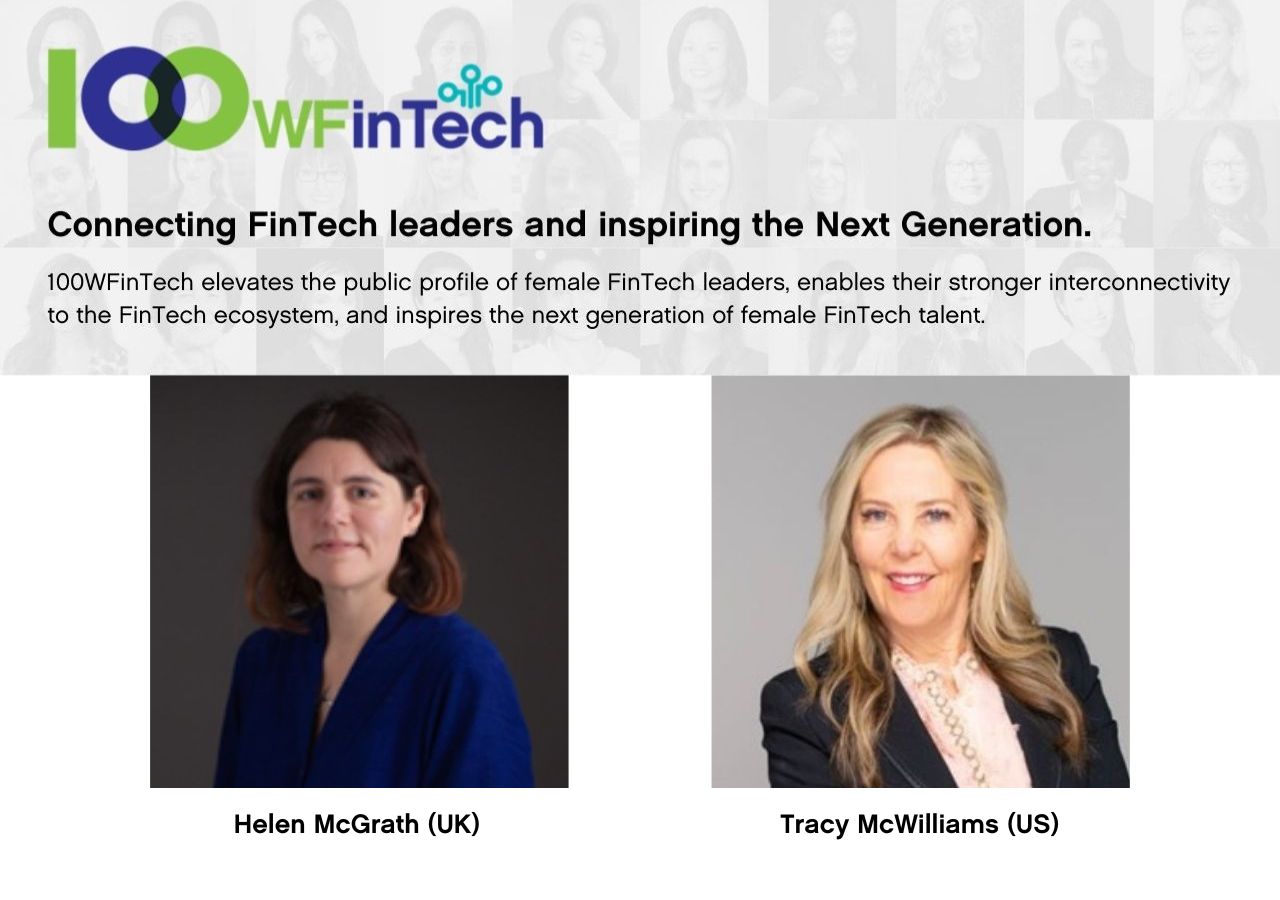
In this ‘100WFinTech Changemakers’ series, we highlight Helen McGrath (UK) and Tracy McWilliams (US), two senior fintech leaders who have created opportunities that were open to them via their thought leadership, entrepreneurship, investing, and community building. In the process, they open doors for women investors and diverse founders and broaden financial access for many. We hope the stories of these female FinTech leaders can inspire the next generation of finance professionals to build a better and more inclusive world by leveraging technology.
If these stories and missions resonate with you, please share them with your network, get in touch with us, or join the Public Directory.
 Helen McGrath
Head of Local Payment Methods of Stripe
Location: United Kingdom
LinkedIn: https://www.linkedin.com/in/helencmcgrath/
Website: www.stripe.com
First, we chat with Helen McGrath, Head of the Global Payment Methods Program at Stripe. Stripe providers programmable financial services for businesses. Millions of companies—from SMEs and ambitious startups to the world’s largest enterprises—use Stripe to accept payments, grow their revenue, and accelerate new business opportunities. Helen serves as a director on the UK board, and her team is responsible for the majority of Stripe’s non-card payment methods, including wallets, BNPL (Buy Now Pay Later) providers and bank transfers. Helen also contributes to the work of Stripe’s Policy team on new European payments initiatives, and regularly speaks at industry events and conferences.
Helen has worked in the payment services industry for over 15 years. Prior to Stripe, she worked as a regulatory lawyer in private practice, advising a range of institutions from fintechs to global banks on regulatory issues and corporate transactions. Based in the United Kingdom, she graduated from The University of Cambridge, and is active in several women’s and industry initiatives, including being a member of the European Women Payments Network and the FMLC Finance and Technology Scoping Forum.
Helen will talk about her career journey, why she joined Stripe, and what she’s most excited about the future of payments.
▪ ▪ ▪
In your career journey, what brought you to the digital payment space at Stripe?
I’ve always looked to pursue opportunities in my career that have presented new challenges for me and have given me the opportunity to grow and learn something new. I had been a private practice lawyer for a number of years when I was seconded to JP Morgan to work with their equities and commodities trading business. I found that I really enjoyed that experience, particularly being embedded in a business and really learning and seeing that business in an end-to-end way that I hadn’t been able to previously as an external advisor. I realised then how much I could learn by moving to an in-house role instead of staying in private practice.
When I moved to Stripe, the company was less than 700 people (versus the 8,000+ it is today). I had worked with Stripe for a number of years, and had always really liked the people there, but I think what really inspired me to move was the company mission. Stripe’s mission is to grow the GDP of the internet. Stripe is a different company now from the one I joined, but that mission has been a constant and ultimately that mission is what drove me to move to Stripe and is what keeps me here. Stripe helps businesses get started that, without Stripe, wouldn’t exist. That story of economic enablement is really powerful to me.
What have you learned in the process?
First, your career is long, and it’s OK to take some risks in your career and for some of your career moves to be bad ones – if you make a change and it doesn’t work out, it’s likely that the worst thing that will happen is you’ll need to find a new role, but you’ll have new experiences and knowledge to take with you. The best career choices I’ve made were risky – when I moved to Stripe it was less established than it is today, and I was moving to a very differently shaped role and organisation. Similarly when I moved from being a lawyer at Stripe to my current role in the business, that was a really large change in role scope. Both moves involved risk, but in the end they both left me challenged in a positive way.
Second, any career planning or development needs to be rooted in deep self-knowledge and reflection. Ultimately no-one else can tell you what is most important to you and what you will find rewarding. I’d strongly encourage anyone thinking about a career move to first sit down and make sure you know what your core values are, and how you want to be spending your time in the day to day to feel fulfilled (if you struggle with this, think about the things in your life that you find particularly triggering or frustrating – this is likely the case because there’s a conflict with one of your core values). Only then can you identify roles that are going to suit you.
What are you most excited about in the future for payments?
Stripe’s mission is to increase the GDP of the internet, and the internet is inherently global. There are still a lot of barriers to global trade. For example, in some cases a cross-border payment can cost up to 10 times more than a domestic payment, with long processing times, currency conversion, and dealing with multiple intermediaries. Why? Because most of the world’s payment systems were designed decades ago, before the internet existed. As an industry we’ve spent decades trying to make old systems “work” for a digital, global economy they were never built for.
Two technologies — real-time payments and stablecoins — have the potential to change this and I’m really excited to see them come to fruition. In many cases they’re already fast, cheap, and borderless. Real-time payments are laying the groundwork country by country for instant money movement, and stablecoins are stitching those countries together into a truly global network. There is so much promise in these two technologies, particularly when used together!
 Tracy McWilliams
CEO of Inspire Global Ventures, General Partner of Inspire Global Ventures Fund I, Founder of Jaspy.ai, Co-Founder of Digital Evolution Institute
Location: United States
LinkedIn: https://www.linkedin.com/in/tracymcwilliams/
Website: www.inspireglobalventures.com
Tracy McWilliams is an investor and board member to teams, technologies and firms that disrupt their industries. She bridges her experience as an investment banker with managing her family office, a passion for entrepreneurship (3rd generation), and advocacy of technologies that inspire breakthrough problem-solving.
She is the founder, investor, and CEO of Inspire Global Ventures and General Partner of the Inspire Global Ventures Fund focused on early-stage investing in technologies providing operational efficiencies and risk management in IoT, Supply Chain, Automation, Data Management and Fintech – Blockchain, Tokenization. She is also the founder of Jaspy.ai, a platform focused on wealth and data management and co-founder of Digital Evolution Institute, an investor and family office community which advances thought leadership at the intersection of investment, technology and entrepreneurship.
▪ ▪ ▪
Your career journey spans investment banking, technology investing, entrepreneurship, thought leadership, etc. What have been your career inflection points and your most important lessons?
The most important lesson I learned on my career journey is that success is about the people you build relationships with; their support, mentorship and collaboration.
Investment banking taught me about core business values based on financial analysis and valuation. In investing, especially in early-stage technology companies, founders play a key role in valuing the company and business model. When investing personal or fund capital, the role and vision of the founder is crucial. This is an important lesson. Through all scenarios, early-stage companies that became successful were because of the founders, the best idea does not guarantee success. I evaluate founders through our fund investments and in Jaspy.Ai, the wealth technology company where we are building a team.
At each pivotal moment in my career, the guiding principle has remained consistent: success is fundamentally driven by people. Entrepreneurship can be a path less traveled and many times alone. Having great mentors, advisors, that believe in your vision and investing in entrepreneurs that will fight for success and their investors is important. I value working with exceptional people and investing in the future that will impact the world globally as technology and specifically fintech does.
What areas of FinTech development are you most excited about right now, and what keeps you up at night?
I’m most excited about the future of operational efficiencies in companies and the expansion of financial technologies creating liquidity.
The biggest issue for risk mitigation in venture and private alternative investing is liquidity. Private investments need time to grow and execute business models; unexpected pathways happen; having liquidity options earlier in the growth phase changes the analysis and commitment on investment. Having multiple choices on timing for exit strategies and the yield associated with each provides flexibility with invested capital. Future proofing investments for investors and creating liquidity earlier. Balancing time and the ability for capital to grow is essential for liquidity and the options around tokenization.
Making good decisions for all parties, companies, investors, people and staying focused on investor return while managing fund investments and a wealth management early stage company is what I think about the most. Since I am an investor and have invested personal capital for many years, I take the trust placed in me and my vision very seriously. Making sure I maintain operation efficiencies in our fund, technology company and paying attention to capital I have deployed to exceptional founders is essential. Understanding the future is here quickly and thoughtful decisions need to be made to ensure capital preservation and growth. We all need input at times as we make operational and financial decisions around investments and scaling companies; knowing every decision was made thoroughly, information and guidance is important. Having advisors, or trusted teams is crucial in this process.
How do you think leaders in financial services can navigate in this new era of AI-powered transformation?
Leaders understand that all decisions can’t be made at once. AI and its impact in financial services is evolving. AI and the ability to implement strategies around these technologies must be made through the lens of customer needs, customer service and the broader picture of changes in the financial landscape including payments, digital identity, tokenization and blockchain. Purchasing AI companies, implementing in-house strategies or a combination thereof require a step-by-step analysis. Being mindful of the changes taking place will allow leaders to pivot as changes are solidified around the new era of AI transformation.
How would you advise the younger generation of women who want to follow in your footsteps, as investors and entrepreneurs?
Entrepreneurship is a great path and being an investor is very rewarding. Choose your path based on your values and lifestyle. Entrepreneurs work long hours, the time commitment, and the multiple roles you must take on is extensive. Believe in your vision always. Build strong relationships for your journey over time. As an investor, commitment extends beyond finances and can include providing strategic guidance. Set forth clear goals for the type of investments you will make. Understand that as you learn more and gain more experience making better choices is a natural process of moving forward with your vision.
Upcoming events organized or co-hosted by 100WFinTech are as follows:
September 1, 2025, in-person, London, “Retail Investing, AI and Digital”, produced by 100WFinTech and sponsored by LSEG
September 30, 2025, in-person event, Munich, “AI in Wealth: Fintech’s Innovation Frontier”, produced by 100WFinTech and sponsored by Allianz Global Investors and Plug and Play and in collaboration with Swiss Fintech Ladies
▪ ▪ ▪
This is the thirteenth article of our Changemakers in FinTech series. In the future, we will continue to feature FinTech book authors, TED Talk Speakers, lecturers, and influencers from around the world.
If you are interested in partnering with us at 100 Women in FinTech, please visit our website and contact us here.